REB Hosts National Business Pitch Competition Boot Camp to Showcase Student Innovation
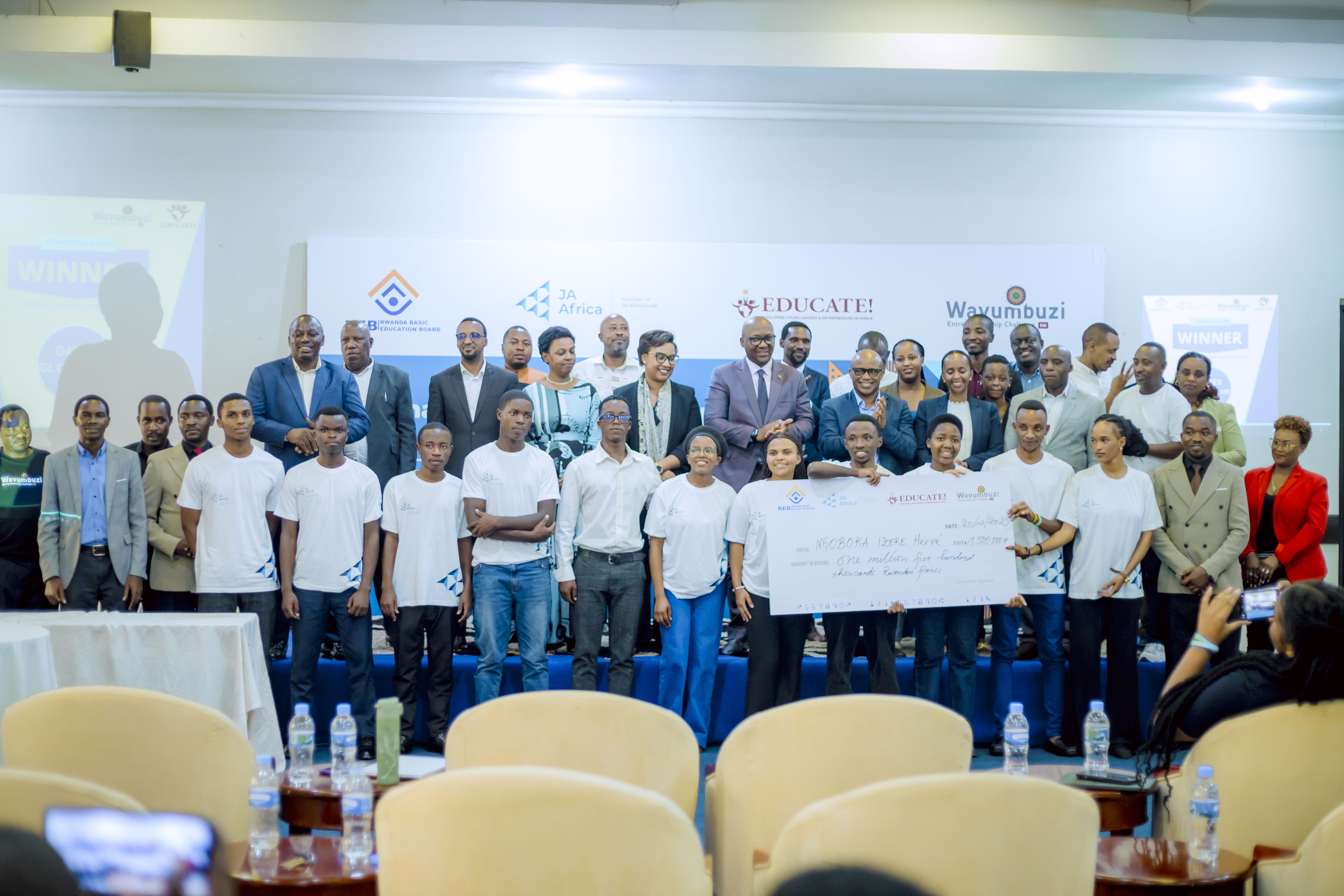
The Rwanda Basic Education Board (REB), in partnership with Educate! Wavumbuzi, and Junior Achievement Africa (JAA), is hosting a National Business Pitch Competition Boot Camp that brings together some of Rwanda’s most promising young innovators from Senior Six across the country.
A total of 78 student business projects, selected from all 30 districts through school- and district-level competitions, were invited to the national boot camp as part of efforts to strengthen youth entrepreneurship and innovation within the education system. The initiative aims to bridge the gap between learning and real-world problem solving by equipping learners with practical business skills.
From 14 to 16 December 2025, students took part in hands-on coaching sessions designed to strengthen their business ideas and pitching skills. The boot camp provided practical guidance on refining business concepts, understanding markets, and presenting ideas with confidence. This process laid the foundation for a competitive national pitching stage that highlights student creativity and innovation.
During the first round of the National Business Pitch Competition, 30 student projects were selected from the 78 submissions after a rigorous evaluation process. The selected projects included 14 female-led and 16 male-led initiatives, reflecting balanced gender participation and strong innovation potential. Further assessment led to the selection of 10 projects that advanced to the final round of the competition.
The competition concluded on 20 December 2025, with the remaining teams pitching their ideas in the final round. At the end of the process, five outstanding student-led projects were awarded for their innovation, feasibility, and potential impact on society.
In his opening remarks, the Director General of REB, Dr. Nelson Mbarushimana, noted that the competition demonstrates the results of the revised Entrepreneurship curriculum. He explained that the curriculum was redesigned to ensure learners leave secondary school with practical and viable business ideas that can be implemented whether they proceed to higher education or directly into the workforce.
Dr. Mbarushimana highlighted that the curriculum follows a progressive structure. Learners begin by identifying problems in their communities and turning them into business ideas, then move on to developing practical business plans using simplified tools such as the Business Model Canvas. In their final year, students are trained in pitching, enabling them to confidently present their ideas to potential investors, financial institutions, and partners. He added that the competition showcases the achievements of this new approach to teaching entrepreneurship.
In addition to the competition, REB also hosted a National Stakeholder Convening supported by Junior Achievement Africa, which is expanding its work from TVET into General Education. According to Dr. Mbarushimana, bringing stakeholders together helps strengthen alignment between education and entrepreneurship strategies while reinforcing ecosystem support for youth ventures through mentorship, funding, incubation, and partnerships.
In his closing remarks, the Director General emphasized that the initiative is not a one-time event but a strategic intervention aligned with Rwanda’s Vision 2050, which places entrepreneurship at the center of job creation, innovation, and economic transformation. He added that the competition will be complemented by a practical incubation program focused on transforming winning ideas into investment-ready ventures through hands-on implementation and real market testing.
Juliette Kayitesi, one of the judges, explained that projects were evaluated based on their usefulness to the community, their level of innovation, and their realism and feasibility. She noted that many of the ideas were grounded in proper research and addressed real challenges facing Rwandan society, expressing confidence that the country will benefit from strong entrepreneurs emerging from this initiative.
Nehemiah Bacumuwenda, in charge of the Entrepreneurship course at REB, explained that student preparation begins early in secondary school. Learners start by developing business ideas, then progress to writing business plans, and finally learn how to pitch their projects. Competitions begin at school level, advance to district level, and culminate at the national stage after students complete secondary school.
Among the award recipients was Nikubuntu Marie Silencieuse, whose project focuses on supporting people with visual impairments. Inspired by her experiences growing up, she designed smart shoes that produce sound when the wearer encounters obstacles, helping users move independently. She emphasized that disability should not be seen as inability and encouraged young people to focus their studies on solving real problems in society.
The first-place winner, Ngoboka Izere Herve Morin, presented a project addressing challenges faced by passengers at bus stations. His solution introduces a ticket booking system that allows users to purchase tickets independently, even in areas without internet access, helping reduce overcharging, disorder, and congestion.
No 5-Umutoniwase Emelyne wins 500,000RWF; No 4-Nikubuntu Marie Silencieuse wins 700,000RWF; No 3-Mugisha Cedrick wins 900,000RWF; No 2-Umwangange Sharon wins 1,100,000RWF; and No 1- Ngoboka Izere Herve Morin wins 1,500,000RWF.
At the conclusion of the competition, five student projects were recognized for excellence, while other finalists also received support to help them further develop their ideas. REB expressed sincere appreciation to Educate!, Wavumbuzi, Junior Achievement Africa, financial institutions, ecosystem actors, district and school leaders, and all partners whose contributions made the initiative a success.
The National Business Pitch Competition stands as a strong example of how education reforms, partnerships, and innovation can empower young people with the skills and confidence needed to become future entrepreneurs and job creators in Rwanda.
PHOTOS


